Facebook Twitter Gplus LinkedIn YouTube Google Maps E-mail RSS
Showing posts with label Google. Show all posts

06 March 2012

Apple is now more bigger than Microsoft and Google combined

Apple CEO Tim Cook: Apple's stock has soared to a market capitalisation of $460 billion this week, buoyed by results and rumours of new products. The company is now worth more than the entire U.S. Apple's stock has soared to a market capitalisation of $460 billion this week, buoyed by impressive results and rumours of new products around the corner. The tech giant's stock is worth more than the market capitalisations of rivals Google ($196.8bn)  and Microsoft ($256.1bn) combined.

Apple's profits recently passed $1 billion a week and the company now sells a million iPhones a day. Apple's market capitalisation only overtook Microsoft's in May 2010. 
Fortune magazine also pointed out the worthy statistics that Apple's stock is worth more than the gross domestic product of Sweden - $458 billion. Apple is worth more than all the gold in the American Federal Reserve - $350 billion, by Fortune's reckoning - and all the illegal drugs in the world, $321 billion. 

13 September 2011

Study Says: 7.5 million Facebook users are under 13


WASHINGTON — Some 7.5 million of the 20 million minors who used Facebook in the past year were younger than 13, and a million of them were bullied, harassed or threatened on the site, says a study released Tuesday.

Even more troubling, more than five million Facebook users were 10 years old or younger, and they were allowed to use Facebook largely without parental supervision leaving them vulnerable to threats ranging from malware to sexual predators, the State of the Net survey by Consumer Reports found.

Facebook's terms of service require users to be at least 13 years old but many children, or their parents, get around that rule by giving a false birth date when they sign up for the social networking site.

Parents of kids 10 and younger who use Facebook "seem to be largely unconcerned" by their children's use of the site, possibly because they think a young child is less vulnerable to Internet risks, the study says.

But while a 10-year-old might not download pornography on the Internet, he or she does "need protection from other hazards that might lurk on the Internet, such as links that infect their computer with malware and invitations from strangers, not to mention bullies," the study says.

More than five million US households have been exposed in the past year to "some type of abuse" via Facebook, including virus infections, identity theft and bullying, says the study, for which 2,089 US households were interviewed earlier this year.

Consumer Reports urged parents to delete their pre-teens' Facebook accounts -- or ask Facebook to do so by using the site's "report an underage child" form -- and to monitor teenage kids' accounts by friending them or keeping an eye on their activity via siblings' or friends' Facebook pages.

It also called on Facebook to "beef up its screening to drastically reduce the number of underage members."

04 June 2011

BIRTH OF THE FAMOUS NAMES


STRANGE NATURAL CIRCUMSTANCES CREATED THE FAMOUS NAMES


MERCEDES
This was actually the financier's daughter's name.


ADOBE


This came from name of the river Adobe Creek that ran behind the house of founder John Warnock. 


APPLE COMPUTERS

It was the favorite fruit of founder Steve Jobs. He was three months late in filing a name for the business, and he threatened to call 
his company Apple Computers if 
the other colleagues didn't suggest a 
better name by 5 O'clock that evening.


CISCO
It is not an acronym as popularly believed. 
It is short for  San Francisco .


COMPAQ  

This name was formed by using COMp, for computer, and PAQ to denote a small integral object.   


COREL
The name was derived from the founder's 
name Dr. Michael Cowpland. It stands for  COwpland REsearchLaboratory
.


GOOGLE

The name started as a joke boasting about the amount of information the search-engine would be able to search. It was originally named 'Googol', a word for the number represented by 1 followed by 100 zeros. After founders- Stanford graduate students Sergey Brin and Larry Page presented their project to an angel investor, they received a cheque made out to 'Google' ...thus the name.


HOTMAIL 
Founder Jack Smith got the idea of accessing e-mail via the web from a computer anywhere in the world. When Sabeer Bhatia came up with the business plan for the mail service, he tried all kinds of names ending in 'mail' and finally settled for hotmail as it included the letters "html" - the programming language used to write web pages. It was initially referred to as HoTMaiL with selective uppercasing.


HEWLETT PACKARD 

Bill Hewlett and Dave Packard tossed a coin to decide whether the company they founded would be called Hewlett-Packard or Packard-Hewlett. 


INTEL 
Bob Noyce and Gordon Moore wanted to name their new company ' Moore Noyce'but that was already trademarked by a hotel chain so they had to settle for an acronym of INTegrated ELectronics. 


LOTUE (Notes) 

 Mitch Kapor got the name for his company from 'The Lotus Position' or 'Padmasana'. Kapoor used to be a teacher of Transcendental Meditation of  Maharishi Mahesh Yogi.


MICROSOFT 

Coined by Bill Gates to represent the company that was devoted to MICROcomputer SOFTware. Originally christened Micro-Soft, the '-' was removed later on. 


MOTOROLA 

Founder Paul Galvin came up with this name when his company started manufacturing radios for cars. The popular radio company at the time was called  Victrola.


ORACLE 
Larry Ellison and Bob Oats were working on a consulting project for the CIA (Central Intelligence Agency). The code name for the project was called
Oracle (the CIA saw this as the system to give answers to all questions or something such). The project was designed to help use the newly written SQL code by IBM. The project eventually was terminated but Larry and Bob decided to finish what they started and bring it to the world. They kept the name Oracle and created the RDBMS engine. Later they kept the same name for the company
. 


SONY 
It originated from the Latin word 'sonus' meaning sound, and 'sonny' a slang used by Americans to refer to a bright youngster. 


SUN 

Founded by four  Stanford  University buddies, SUN is the acronym for  Stanford  University Network. Andreas Bechtolsheim built a microcomputer; Vinod Khosla recruited him and Scott McNealy to manufacture computers based on it, and Bill Joy to develop a UNIX-based OS for the computer. 


  YAHOO!  

The word was invented by Jonathan Swift and used in his book 'Gulliver's Travels'. It represents a person who is repulsive in appearance and action and is barely human. Yahoo! Founders Jerry Yang and David Filo selected the name because they considered themselves yahoos.


03 March 2011

What Is Google TV?


It's a software platform

You know how the Nexus One is a piece of hardware by HTC that runs Android, a piece of software by Google? That's how Google TV will work. At its heart, Google TV is a platform. It's software. Hardware makers will need to step up to use it in their devices.

Logitech, Sony and DISH support

Right now, there are three places we'll see Google TV: a set top box by Logitech, Sony televisions (and one Blu-ray player) and an upcoming DISH box. They all share the following common specs: An Atom (or better) processor, discrete GPU, HDMI-out, Bluetooth, IR (with a transmitting "blaster"), Wi-Fi, and Ethernet, all while supporting a keyboard and a pointing device, as well as more traditional remotes such as Logitech's Harmony \universals. From what we understand, all of these products will be available at Best Buy in fall of 2010 (though it's possible DISH may be later).

Supports existing cable/satellite box

Equipped with an IR blaster to change channels, Google TV can sit on top of your existing infrastructure. So while new hardware is in the works, it should be compatible with whatever you're using now—cable or satellite boxes, with all relevant subscriptions.

Google search

When you start any Google TV device, you're greeted by a simple search bar. You type what you'd like to watch. That can be a television station, allowing you to select and tune that channel. Or it can be a show, which will point you to places you can find the show—be that through a cable subscription channel, Netflix or somewhere on the web.

Combines the web with TV

So say you want to watch something that only exists on Amazon's streaming service. You'll be taken to Amazon's webpage through Chrome, where the video will stream. Random websites might look crumby on your television, of course, which is why Google asks that sites optimize for Google TV (full SDKs available in 2011). With this mix of web and television, you can also view multiple sources of information in multiple panes. So you can watch the Sox game on one part of your screen while reading Paul Konerko's realtime stats in another.

Combines your TV with your phone...

Thanks to required Google TV hardware specs like Bluetooth and Wi-Fi, you'll be able to load a webpage on your Android phone and beam it to your TV. You can also use your Android phone's voice recognition, effectively making it possible to change channels or search for shows just by talking.

Supports Flash

I'm pretty sure the audience cheered at this part. And when Google says Flash, they mean the videos and the games.


28 February 2011

Is Blogging Only For Money?

When one gives a quick look at the articles written on blogging, the common theme seems to be making money from blogging. The authors invariably talk about adsense and how we can make money from blogs. Is blogging only for making money? Did blogs begin with that idea? Are we losing the direction somewhere?

A blog gives an opportunity to everyone to express himself/herself on the Internet. We feel that we are sharing our deepest thoughts with other members of the world. Blogging is bringing the world nearer to each other like never before. In certain cases, a blog is a great therapy for venting out anger, frustration and other negative feelings, which can otherwise damage the psyche. Blogging was never started with the object of making money on the Internet.

Imagine the scenario when the majority of blogs will somehow try to collect content from different sources and hope that their ad gets clicked. Is that not wasting of quality time? Will such blogs contribute to the Internet at all? Who will visit such blogs? Everyone is busy building a blog that makes money, so why should he/she visit other blogs?

A blog can contribute to very lively discussion. A blog can be a great platform to meet people and talk. A blog is a great way to help budding talents show case their work to the world. Let us not make blogs only as a money making tool.

Enhanced by Zemanta

20 January 2011

5 Things You Didn't Know about Google

Google was originally called BackRub

Like many other booming internet companies, Google has an interesting upbringing, one that is marked by a lowly beginning. Google began as a research project in January 1996 by cofounder Larry Page, a 24-year-old Ph.D. student at Standford University. Page was soon joined by 23-year-old Sergey Brin, another Ph.D. student, forming a duo that seemed destined for failure. According to Google's own corporate information, Brin and Page argued about every single topic they discussed. This incessant arguing, however, may have been what spurred the duo to rethink web-searching and develop a novel strategy that ranked websites according to the number of backlinks (i.e., according to the number of web pages that linked back to a web page being searched), and not based on the number of times a specific search term appeared on a given web page, as was the norm.

Because of this unique strategy, another thing you didn't know about Google is that Page and Brin nicknamed the search engine BackRub. Thankfully, in 1998, Brin and Page dropped the sexually suggestive nickname, and came up with “Google,” a term originating from a common misspelling of the word "googol," which refers to 10100.

The word “google” has become so common, it was entered into numerous dictionaries in 2006, referring to the act of using the Google search engine to retrieve information via the internet.

Google scans your e-mails5 Things You Didn't Know about Google

Nothing in life is perfect -- or without controversy -- and Google is no exception. Google scans your e-mails (at Gmail) through a process called “content extraction.” All incoming and outgoing e-mail is scanned for specific keywords to target advertising to the user. The process has brewed quite a storm of controversy, but Google has yet to back down on its stance.

Google has remained similarly headstrong about other criticisms; in an attempt to remain partisan to local governments, Google removes or does not include information from its services in compliance with local laws. Perhaps the most striking example of this is Google's adherence to the internet censorship policies of China (at Google.cn) so as not to bring up search results supporting the independence movement of Tibet and Taiwan, or any other information perceived to be harmful to the People's Republic of China.

Google Street has further been cited for breaching personal privacy. The service provides high-resolution street-view photos from around the world and has, on numerous occasions, caught people committing questionable acts. Moving from street to satellite, Google Earth has also come under fire from several Indian state governments about the security risks posed by the details from Google Earth's satellite imaging. When all is said and done, there are a lot of criticisms about Google and these few examples merely scratch the surface.

Google spends $72 million a year on employee meals
Seventy-two million dollars a year -- that works out to about $7,530 per Googler (a term Google uses to identify employees). While the exact details vary depending on location (the Google empire spans the globe), employees at Google's California headquarters, aptly entitled the Googleplex, are welcome to at least two free meals a day from 11 different gourmet cafeterias. As if that weren’t enough, another thing you didn’t know about Google is that in addition to the cafeterias, Google offers numerous snack bars that are chock-full of healthy morsels to munch on.

And that's certainly not all. Is your car in a bit of a rut? Not to worry; Google offers on-site car washes and oil changes. The list of perks for working at Google is never-ending, making it no surprise that it's considered the No. 1 place to work, offering: on-site haircuts, full athletic facilities, massage therapists, language classes, drop-off dry cleaning, day cares, and on-site doctors, just to name a few. Oh, and if your dog is stuck at home and feeling a little lonely, just bring him to work -- Google doesn't mind.
Google loses $110 million a year through "I'm Feeling Lucky"

There's not much to see on Google's main search page, and perhaps simplicity is one of the keys to Google's success. When searching Google, you are given two options: “Google Search” or “I'm Feeling Lucky.” By clicking the former, you are given that familiar list of search results; by clicking the latter, however, you are automatically redirected to the first search result, bypassing the search engine’s results page.

besides the fun factor, the idea behind the “I'm Feeling Lucky” feature is to provide the user with instant connection to the precise page they are searching for, thus saving them time that would normally be spent perusing endless search results. Sounds harmless enough, right? Not so fast. Because “I'm Feeling Lucky” bypasses all advertising, it is estimated that Google loses about $110 million per year in advertising- generated revenue. So why in the world would any Fortune 500 company not patch such a gaping leak? "It's possible to become too dry, too corporate, too much about making money. I think what's delightful about 'I'm Feeling Lucky' is that it reminds you there are real people here," Google Executive Marissa Mayer told Valleywag, an online tech-blog.

Google has a sense of humor

Google also offers full language support for Pig Latin, Klingon and even Elmer Fudd. Anyone else still feeling lucky? Try typing, “French military victories” and clicking “I'm Feeling Lucky.” Behold the result.

Some might remember the “miserable failure” fiasco when one typed those words and clicked “I'm Feeling Lucky,” and they were instantly connected to a biography of President George W. Bush on the White House website. Now, before you jump to conclusions, this trick -- which no longer works -- was carried out by members of the online community through the art of “Google bombing.” Google bombing works because of Google's backlink search strategy.
Enhanced by Zemanta

11 January 2011

Tips to Search Better in Google

This is an old one, but very important: Put quotes around phrases that must be searched together. If you put quotes around "electric curtains," Google won't waste your time finding one set of Web pages containing the word "electric" and another set containing the word "curtains."

         Similarly, put a hyphen right before any word you want screened out. If you're looking up dolphins, for example, you'll have to wade through a million Miami Dolphins pages unless you search for "dolphins - Miami."

         Google is a global White Pages and Yellow Pages. Search for "phonebook:home depot norwalk , ct," Google instantly produces the address and phone number of the Norwalk Home Depot. This works with names ("phonebook: robert jones las vegas, NV") as well as businesses.

         Don't put any space after "phonebook." And in all of the following examples, don't type the quotes I'm showing you here.

         Google is a package tracker. Type a FedEx or UPS package number (just the digits); when you click Search, Google offers a link to its tracking information.

         Google is a calculator. Type in an equation ("32+2345*3- 234=").

         Google is a units-of-measuremen t converter. Type "teaspoons in a gallon," for example, or "centimeters in a foot."

         Google is a stock ticker. Type in AAPL or MSFT, for example, to see a link to the current Apple or Microsoft stock price, graphs, financial news and so on.

         Google is an atlas. Type in an area code, like 212, to see a Mapquest map of the area.

         Google is Wal-Mart's computer. Type in a UPC bar code number, such as "036000250015, " to see the description of the product you've just "scanned in." (Thanks to the Google Blog, http://google. blogspace. com , for this tip and the next couple.)

         Google is an aviation buff. Type in a flight number like "United 22" for a link to a map of that flight's progress in the air. Or type in the tail number you see on an airplane for the full registration form for that plane.

          Google is the Department of Motor Vehicles. Type in a VIN (vehicle identification number, which is etched onto a plate, usually on the door frame, of every car), like "JH4NA1157MT001832" to find out the car's year, make and model.

          For hours of rainy-day entertainment, visit http://labs. google.com . Here, you'll find links to new, half-finished Google experiments- like Google Voice, in which you call (650) 623-6706, speak the words you want to search for and then open your browser to view the results. Disclaimer: It wasn't working when I tried it. (Ditto a lot of these experiments.)

Enhanced by Zemanta

19 October 2010

50 things that are being killed by the internet

The web is changing the way we work, play and think 

Below we have compiled - in no particular order - 50 things that are in the process of being killed off by the web, from products and business models to life experiences and habits. We've also thrown in a few things that have suffered the hands of other modern networking gadgets, specifically mobile phones and GPS systems.

Do you agree with our selections? What other examples can you think of? Please post your comments on the bottom of the story – we hope include the best suggestions in a fuller list.

1) The art of polite disagreement
While the inane spats of YouTube commencers may not be representative, the internet has certainly sharpened the tone of debate. The most raucous sections of the blogworld seem incapable of accepting sincerely held differences of opinion; all opponents must have "agendas". 


2) Fear that you are the only person unmoved by a celebrity's death Twitter has become a clearing-house for jokes about dead famous people. Tasteless, but an antidote to the "fans in mourning" mawkishness that otherwise predominates.

3) Listening to an album all the way through
The single is one of the unlikely beneficiaries of the internet – a development which can be looked at in two ways. There's no longer any need to endure eight tracks of filler for a couple of decent tunes, but will "album albums" like Radiohead's Amnesiac get the widespread hearing they deserve?


4) Sarah Palin
Her train wreck interviews with NBC's Katie Couric were watched and re-watched millions of times on the internet, cementing the Republican vice-presidential candidate's reputation as a politician out of her depth. Palin's uncomfortable relationship with the web continues; she has threatened to sue bloggers who republish rumours about the state of her marriage.


5) Punctuality
Before mobile phones, people actually had to keep their appointments and turn up to the pub on time. Texting friends to warn them of your tardiness five minutes before you are due to meet has become one of throwaway rudenesses of the connected age.


6) Ceefax/Teletext
All sports fans of a certain age can tell you their favourite Ceefax pages (p341 for Test match scores, p312 for football transfer gossip), but the service's clunking graphics and four-paragraph articles have dated badly. ITV announced earlier this year that it was planning to pull Teletext, its version.


7) Adolescent nerves at first porn purchase
The ubiquity of free, hard-core pornography on the web has put an end to one of the most dreaded rights rites of passage for teenage boys – buying dirty magazines. Why tremble in the WHSmiths queue when you can download mountains of filth for free in your bedroom? The trend also threatens the future of "porn in the woods" – the grotty pages of Razzle and Penthouse that scatter the fringes of provincial towns and villages.


8) Telephone directories
You can find Fly Fishing by J R Hartley on Amazon.


9) The myth of cat intelligence
The proudest household pets are now the illiterate butts of caption-based jokes. Icanhasreputashunba ck?


10) Watches
Scrabbling around in your pocket to dig out a phone may not be as elegant as glancing at a watch, but it saves splashing out on two gadgets.


11) Music stores
In a world where people don't want to pay anything for music, charging them £16.99 for 12 songs in a flimsy plastic case is no business model.


12) Letter writing/pen pals
Email is quicker, cheaper and more convenient; receiving a handwritten letter from a friend has become a rare, even nostalgic, pleasure. As a result, formal valedictions like "Yours faithfully" are being replaced by "Best" and "Thanks".


13) Memory
When almost any fact, no matter how obscure, can be dug up within seconds through Google and Wikipedia, there is less value attached to the "mere" storage and retrieval of knowledge. What becomes important is how you use it – the internet age rewards creativity.


14) Dead time
When was the last time you spent an hour mulling the world out a window, or rereading a favourite book? The internet's draw on our attention is relentless and increasingly difficult to resist.


15) Photo albums and slide shows
Facebook, Flickr and printing sites like Snapfish are how we share our photos. Earlier this year Kodak announced that it was discontinuing its Kodachrome slide film because of lack of demand.


16) Hoaxes and conspiracy theories
The internet is often dismissed as awash with cranks, but it has proved far more potent at debunking conspiracy theories than perpetuating them. The excellent Snopes.com continues to deliver the final, sober, word on urban legends.


17) Watching television together
On-demand television, from the iPlayer in Britain to Hulu in the US, allows relatives and colleagues to watch the same programmes at different times, undermining what had been one of the medium's most attractive cultural appeals – the shared experience. Appointment- to-view television, if it exists at all, seems confined to sport and live reality shows.


18) Authoritative reference works
We still crave reliable information, but generally aren't willing to pay for it.


19) The Innovations catalogue
Preposterous as its household gadgets may have been, the Innovations catalogue was always a diverting read. The magazine ceased printing in 2003, and its web presence is depressingly bland.


20) Order forms in the back pages of books
Amazon's "Customers who bought this item also bought..." service seems the closest web equivalent.


21) Delayed knowledge of sporting results
When was the last time you bought a newspaper to find out who won the match, rather than for comment and analysis? There's no need to fall silent for James Alexander Gordon on the way home from the game when everyone in the car has an iPhone.


22) Enforceable copyright
The record companies, film studios and news agencies are fighting back, but can the floodgates ever be closed?


23) Reading telegrams at weddings
Quoting from a wad of email printouts doesn't have the same magic.


24) Dogging
Websites may have helped spread the word about dogging, but the internet offers a myriad of more convenient ways to organise no-strings sex with strangers. None of these involve spending the evening in lay-by near Aylesbury.


25) Aren't they dead? Aren't they gay?
Wikipedia allows us to confirm or disprove almost any celebrity rumour instantly. Only at festivals with no Wi-Fi signals can the gullible be tricked into believing that David Hasselhoff has passed away.


26) Holiday news ignorance
Glancing at the front pages after landing back at Heathrow used to be a thrilling experience – had anyone died? Was the government still standing? Now it takes a stern soul to resist the temptation to check the headlines at least once while you're away.


27) Knowing telephone numbers off by heart
After typing the digits into your contacts book, you need never look at them again.


28) Respect for doctors and other professionals
The proliferation of health websites has undermined the status of GPs, whose diagnoses are now challenged by patients armed with printouts.


29) The mystery of foreign languages
Sites like Babelfish offer instant, good-enough translations of dozens of languages – but kill their beauty and rhythm.


30) Geographical knowledge
With GPS systems spreading from cars to smartphones, knowing the way from A to B is a less prized skill. Just ask the London taxi drivers who spent years learning The Knowledge but are now undercut by minicabs.


31) Privacy
We may attack governments for the spread of surveillance culture, but users of social media websites make more information about themselves available than Big Brother could ever hoped to obtain by covert means.


32) Chuck Norris's reputation
The absurdly heroic boasts on Chuck Norris Facts may be affectionate, but will anyone take him seriously again?


33) Pencil cricket
An old-fashioned schoolboy diversion swept away by the Stick Cricket behemoth


34) Mainstream media
The Seattle Post-Intelligencer and Rocky Mountain News in the US have already folded, and the UK's Observer may follow. Free news and the migration of advertising to the web threaten the basic business models of almost all media organisations.


35) Concentration
What with tabbing between Gmail, Twitter, Facebook and Google News, it's a wonder anyone gets their work done. A disturbing trend captured by the wonderful XKCD webcomic.


36) Mr Alifi's dignity
Twenty years ago, if you were a Sudanese man who was forced to marry a goat after having sex with it, you'd take solace that news of your shame would be unlikely to spread beyond the neighbouring villages. Unfortunately for Mr Alifi, his indiscretion came in the digital age – and became one of the first viral news stories.


37) Personal reinvention
How can you forge a new identity at university when your Facebook is plastered with photos of the "old" you?


38) Viktor Yanukovych
The Orange Revolution in Ukraine was organised by a cabal of students and young activists who exploited the power of the web to mobilise resistance against the old regime, and sweep Viktor Yushchenko to power.


39) The insurance ring-round
Their adverts may grate, but insurance comparison websites have killed one of the most tedious annual chores


40) Undiscovered artists
Posting paintings to deviantART and Flickr – or poems to writebuzz – could not be easier. So now the garret-dwellers have no excuses.


41) The usefulness of reference pages at the front of diaries
If anyone still digs out their diaries to check what time zone Lisbon is in, or how many litres there are to a gallon, we don't know them.


42) The nervous thrill of the reunion
You've spent the past five years tracking their weight-gain on Facebook, so meeting up with your first love doesn't pack the emotional punch it once did.


43) Solitaire
The original computer timewaster has been superseded by the more alluring temptations of the web. Ditto Minesweeper.


44) Trust in Nigerian businessmen and princes
Some gift horses should have their mouths very closely inspected.


45) Prostitute calling cards/ kerb crawling
Sex can be marketed more cheaply, safely and efficiently on the web than the street corner.


46) Staggered product/film releases
Companies are becoming increasingly draconian in their anti-piracy measure, but are finally beginning to appreciate that forcing British consumers to wait six months to hand over their money is not a smart business plan.


47) Footnotes Made superfluous by the link, although Wikipedia is fighting a brave rearguard action.

48) Grand National trips to the bookmaker
Having a little flutter is much more fun when you don't have to wade though a shop of drunks and ne'er-do-wells


49) Fanzines
Blogs and fansites offer greater freedom and community interaction than paper fanzines, and can be read by many more people.


50) Your lunchbreak
Did you leave your desk today? Or snaffle a sandwich while sending a few personal emails and checking the price of a week in Istanbul?


Enhanced by Zemanta

13 October 2010

The Top Ten Harmful Viruses & Anti Viruses

In simple terms, a virus can aptly be called a virtual disease which affects a computer system and makes it sick, forcing to act in a manner undesired by the user. No good deed goes unpunished, and with the joys and leisure that were brought by the computer, along came the viruses to ruin all the fun. There are billions of viruses out there, big and small. But there were some that stood out and ruined things for us in a spectacular fashion. Below is a list of 10 of the deadliest virus which create havoc in the virtual as well as the real world. 
 
I love you
The three words that can at most motivate you to cross the seven seas - or at least tempt you to open en email. This very temptation was the downfall of many computer users when this multipurpose- multi skilled virus hit the web. It had the ability to replicate itself via IRC chat and email, transfer and hide itself in different files and folders, and infect the registry keys once you opened an email in you inbox declaring “I Love You”. The virus thought to be originated somewhere in the Philippines, caused damage which was estimated to be around $8-10 billion.
Melissa
The creator of this virus received a 20 month jail sentence and a $5000 fine. Generated over a decade ago, this clever piece of virtual disease operated through Microsoft Outlook. This is how it worked: you receive an email titled “Here is the Document you asked for” from an unknown sender, you got infected as soon as you opened the email, and the virus would replicate and delivers itself to the top 50 people on your list without you getting a hint of it. Some major US government departments were hit and the damage is thought to be around $1 billion at least. A 20 month jail sentence well deserved.
  
MyDoom
MyDoom was instigated somewhere in mid 2004 and it actually prompted US senator to propose the creation of a “National Virus Response Centre”. The virus attacked in two phases; the first phase infected different Operating Systems, creating inroads and backdoors and making them vulnerable to external users. Once this problem was sorted out, the MyDoom struck again after few months, this time targeting the Search Engines like Google, slowing them down considerably, and crashing a few.
Nimda 
Spell it backwards and you will understand its prime targets: yes, the ‘Admin’ and servers. It was basically a worm and has the record of being the fastest ever virus to spread; it took only 22 minutes to break into the list of top ten most deadly viruses of all times. It basically targeted internet servers and websites, creating a mass crater through which thousands of computers were affected at the same time. Once infected, the systems became exposed to open attacks by the outsiders.
 
Code Red 
Damages of almost $200 million a day, and affecting the computers inside the White House are the degree of achievements of this virus. It subjugated the Windows by acting as a buffer overflow, sending humongous amount of information to the computer so that it spilt over, eventually forcing a shut down by overlapping the memory of the computers. The problem wasn’t solved until Microsoft issued a revival package to cater for this virus.
SQL Slammer/Saphire
Another swiftly spreading virus, it hit 75,000 computers in the first 10 minutes of its inception, taking down and severely damaging numerous American Banks, Security systems and organizations, and Airline networks. And the virus wasn’t just privy to the US; it ruthlessly damaged the internet capacity of South Korea for at least half a day. The damage was estimated around at least a billion dollars.
Storm Worm 
One of the latest and most recent viruses to strike the internet, the Storm Worm employed a similar strategy to the one used by the Melissa; the mail’s title mentioned a current natural disaster like an earthquake (but most often a storm). Once the email was opened, the virus spread around like wild fire, affecting registries and documents across the hard disk. It turned out to be a mother-virus, instigating numerous hidden programs in the background which made the PC vulnerable and enticing to hackers.
Klez 
With the mix characteristics of a virus, worm and a Trojan horse, Klez gave the antivirus programs a real headache by simply disabling them and making them look like a joke. However this is only the beginning of its trickery; after it was thought it be defeated, it was taken over, decoded and customized by black hat hackers (hackers who specialize in unauthorized penetration) . Its ability was enhanced by providing it with the capability to "spoof" from the user's address book and make it look like that an email came from them, increasing the chances of the receiver opening the email and becoming the next casualty.
Sasser
Damaging the computer through network ports, Sasser mostly targeted Windows 2000 and XP. It’s main casualties were the news agency Agence France-Presse (AFP) which had all its satellite communications jammed for hours , U.S. Airlines which had to reschedule its flights because of the worm had depleted their computers, a Finnish insurance company which was forced to close down 130 of its offices on emergency basis, Goldman Sachs, and Deutsche Post were all badly affected as well. However its unique feature was that it did not spread through emails, but rather observed computers and kept a look out for their vulnerabilities. On the basis of its knowledge, it would scan random IP addresses from the database and send itself to the next victim.
  
Autorun  
This virus primarily targeted USBs and flash drives and established them as its major source of movement and propagation. It affected networks and all the computers present on them. Once affected, the folder options would be disabled, the task manager too would be unavailable and the virus itself would become the system administrator. The virus would replicate itself in all the folders, therefore eating up useful space on the hard disk and making it eventually extremely slow. The loss was in terms of useful data on millions of computers across the world. 
Related articles 

24 August 2010

Rare Photos Collection PART - II

Ken Thompson (L)and Dennis Ritchie(R) ,creators of UNIX.
Dennis Ritchie improved on the B programming language and called it 'New B'.
B was created by Ken Thompson as a revision of the Bon programming language (named after his wife Bonnie)
He later called it C. 

Larry Page(L) and Sergey Brin(R), founders of Google.
Google was originally named 'Googol'.
After founders (Stanford graduates) Sergey Brin and Larry Page presented their project to an angel investor...
they received a cheque made out to 'Google' !...
So they kept name as GOOGLE 


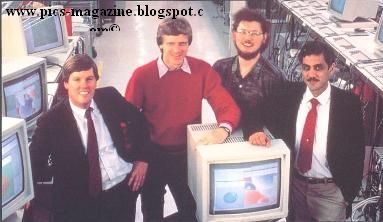
Andreas Bechtolsheim , Bill Joy, Scott Mc Nealy and Vinod Khosla of SUN(StanfordUnivers ity Network) MicroSystems.
Founded by four StanfordUniversity buddies.
Andreas Bechtolsheim built a microcomputer;
Vinod Khosla recruited him;
Scott McNealy to manufacture computers based on it;
and Bill Joy to develop a UNIX-based OS for the computer...
SUN is the acronym for Stanford University Network .


AND THIS PICTURE WAS TAKEN WHEN SUPERHIT SHOLEY WAS STARTED..... .
They were looking at ashrani when he was doing practice first time with his funny Jailer's dress... ALONE on one rock..


Related articles
Enhanced by Zemanta

Ads